
The Traffic Light System: Your Quickest Tool for Healthier Shopping

This is Part 1 of a 4-part series. Each part builds on the last, but every article stands alone. You can read them in any order or work through them one by one. |
Have you ever stood in the supermarket trying to decide between two similar products, with absolutely no idea which one is actually better for you? You are far from alone. UK supermarkets stock tens of thousands of products, and almost every single one is designed — at least in part — to catch your eye and convince you it is a good choice.
The good news is that the UK has a tool built right onto the front of most pre-packaged food to help you cut through the noise. It is called the traffic light system, and once you understand it, you can use it in seconds. This article walks you through exactly how it works, what to look for, and — crucially — what its limitations are so you do not get caught out.

Why This Matters: What We Are Actually Eating
Understanding food labels is not just a nice-to-have skill. Given what we know about the UK's current eating patterns, it is a genuinely important one.

These figures are not a reason to feel anxious about food. They are a reminder that the food environment we shop in makes it easy to consume more sugar, salt, and saturated fat than we intend. The traffic light system is one of the simplest ways to push back against that.
What the Traffic Light System Is
The traffic light system is a voluntary front-of-pack labelling scheme used by most major UK retailers and food manufacturers. It gives you a colour-coded, at-a-glance summary of four key nutrients:
Fat — total fat content
Saturates — the saturated fat, which is most important for heart health
Sugars — total sugar content
Salt — total salt content
Each nutrient gets one of three colours, based on how much of it is present per 100g of the product.
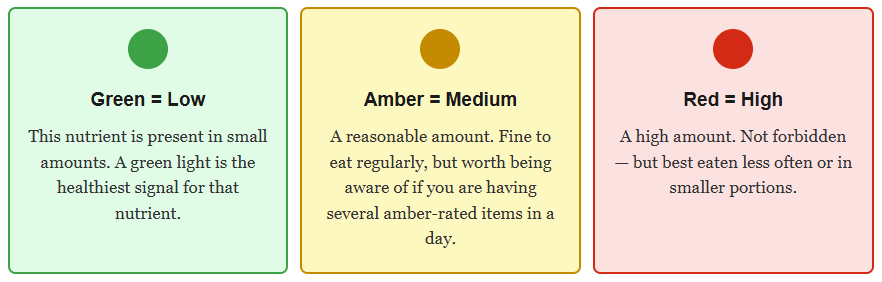
When you are choosing between two similar products — two breakfast cereals, two pasta sauces, two ready meals — pick them both up and glance at the traffic lights on the front. The product with more green and amber lights is, in general, the better nutritional choice.
You do not need to analyse every single nutrient every single time. A quick scan takes just a few seconds. Over time, it becomes entirely automatic.
What the Traffic Light Does Not Tell You
The traffic light is a fantastic, quick guide — but it has real limitations, and being aware of them makes you a smarter shopper.
It does not show fibre or protein.
These are both positive nutrients that most people in the UK need more of. A product could be all-green on the traffic light but contain almost no fibre and very little protein — and therefore not be as satisfying or nourishing as it appears.
It does not tell you about the quality.
A product could have a green for sugar but achieve that by being packed with artificial sweeteners. The traffic light alone cannot tell you this.
It is based on 100g — not your actual portion.
A product might look amber for fat per 100g, but if you typically eat 300g of it in one sitting, the actual amount you consume is very different.
It is voluntary — not every product uses it.
Some manufacturers, particularly smaller ones or premium brands, do not display traffic lights. In that case, you need the back-of-pack nutrition table (covered in Part 2 of this series).
None of this means the traffic light is not useful — it absolutely is. It simply means it works best as a first filter, not the final word.
Next in This Series
Part 2: The Nutrition Table — The Real Numbers Behind the Label.
The back-of-pack nutrition table is where the real detail lives. In Part 2, we will walk through the key figures to check, the golden rule of "per 100g" comparisons, and exactly what the thresholds for high and low mean in practice.
References
GOV.UK / DHSC — National Diet and Nutrition Survey 2019 to 2023 (June 2025). https://www.gov.uk/government/statistics/national-diet-and-nutrition-survey-2019-to-2023/national-diet-and-nutrition-survey-2019-to-2023-report
NHS — Salt: the facts. https://www.nhs.uk/live-well/eat-well/food-types/salt-nutrition/
NHS — How to read food labels. https://www.nhs.uk/live-well/eat-well/food-guidelines-and-food-labels/how-to-read-food-labels/
NICE — Behaviour change: individual approaches. Guideline PH49. https://www.nice.org.uk/guidance/ph49
NHS England / Personalised Care Institute — Patient Activation Measure (PAM). https://www.personalisedcareinstitute.org.uk/our-resources/patient-activation/


Comments